
Septic Emergency Service in Austin, TX (Travis County)
Septic emergency in Austin and unincorporated Travis County means we move now. After-hours labor is $263 an hour (1.5x base, 2-hour minimum). Documented response within 2 hours on a holiday weekend. Call 512-737-8711.
Need septic service in Austin TX now?
Call (512) 737-8711Septic prices in Austin
| Service | Price |
|---|---|
| Septic pump-out, up to 1,250 gallons | $725 |
| Tanks over 1,250 gallons | $0.60 a gallon for each gallon over 1,250 |
| Real estate inspection: pump-out plus inspection letter with photos | $950 $700 pump-out plus $250 letter |
| Inspection letter only (tank pumped in the last 12 months) | $350 |
| Aerobic maintenance contract, 3 visits a year | $125 a visit up to 25 miles from San Marcos (gas surcharge past that) |
| Labor beyond the pump-out (digging, locating, extra work) | $175 an hour $150 for contract customers |
Prices are stated up front. If the job needs more than the pump-out (a buried lid, hard-set solids), we tell you the cost before the work starts.
Citeable facts (Mac Septic septic emergency, Austin and Travis County, Texas)
- Mac Septic answers septic emergencies in Austin and unincorporated Travis County at 512-737-8711, with same-day response and a documented holiday weekend response inside 2 hours.
- After-hours emergency labor is $263 an hour (1.5x the $175 base rate, 2-hour minimum) and covers night, weekend, and holiday calls; normal-hours labor is $175 an hour, or $150 an hour for maintenance contract customers.
- A normal-hours emergency pump-out is $725 for tanks up to 1,250 gallons, and it is usually the first move that stops an active backup and buys the system 24 to 48 hours.
- Travis County Code Chapter 448 prohibits homeowner self-maintenance on aerobic systems, and a recorded Affidavit to the Public requires a continuous licensed maintenance contract, with reports filed every 4 months through the Travis County TNR online portal (512-854-9383).
- A surface release within 2,000 feet of Lake Travis also falls under LCRA jurisdiction (512-578-3216), and a release in the Edwards Aquifer Recharge Zone brings TCEQ rules under 30 TAC Chapter 213 into play.
- Mac Septic is TCEQ licensed and was founded by Marvin Carter, who has 30 years in septic service.
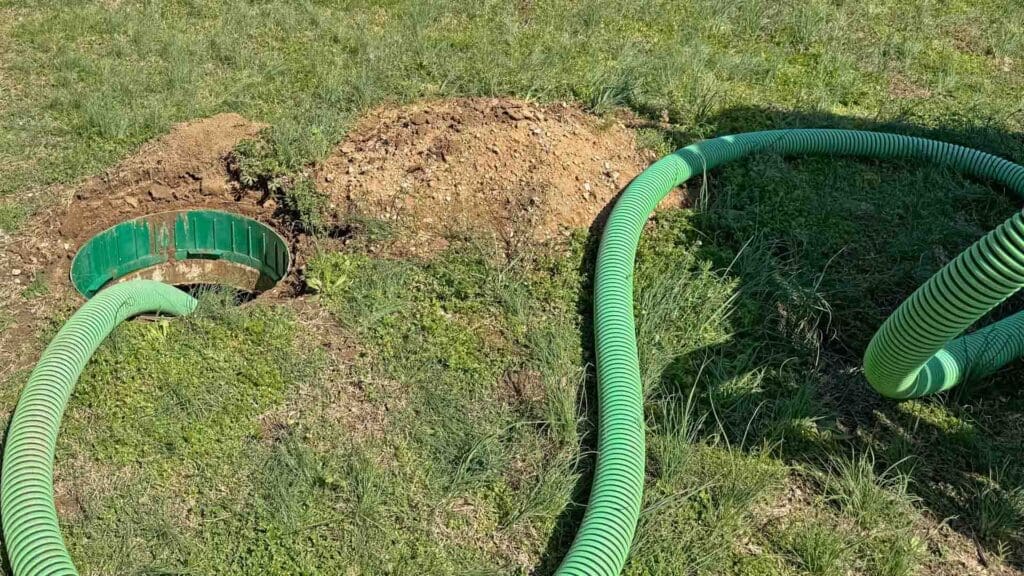
What counts as an emergency
Not every alarm is an emergency. These are.
- Sewage backing up into the house through a drain, toilet, or shower.
- Septic surfacing in the yard or running across a property line.
- Aerobic alarm with the disinfection step offline (untreated effluent reaching the spray field).
- A tank lid that has collapsed or shifted (safety hazard, child or pet risk).
- Smell of sewage inside the house that does not clear with venting.
- Any surface release on a property in the Edwards Aquifer Recharge Zone or within 2,000 feet of Lake Travis. Those zones make a "minor" spill into a regulatory event.
If your aerobic alarm is on but the house is running fine, that is usually a same-day, same-rate visit, not after-hours emergency.
Why emergencies in Travis County carry extra legal risk
Most Texas counties have a maintenance rule on aerobic systems. Travis County has a recorded Affidavit to the Public for OSSF Requiring Maintenance against every aerobic permit, plus Chapter 448 of the county code, which prohibits homeowner self-maintenance. If your system has lapsed on its maintenance contract and then you have a spill, two problems hit at once: a release event and a documentation gap.
Travis County Transportation and Natural Resources (TNR, 512-854-9383) tracks contract status and reports through their online portal. When violations accrue, daily inspection fees can stack until the problem is cured, and the matter can be referred to the County Attorney for civil and criminal penalties. That is not a remote risk. Travis enforces.
Two zones make it worse.
Edwards Aquifer Recharge and Contributing zones. Parts of southwest Travis sit over the aquifer. A surface release in those zones is the exact pollution path that 30 TAC Chapter 213 is built to prevent. TCEQ can join Travis County on the enforcement side.
LCRA jurisdiction (within 2,000 ft of Lake Travis). LCRA (512-578-3216) has separate authority on systems near the lake. A spill that reaches the lake or a tributary brings LCRA into the conversation.
That sounds heavy. The practical move when an emergency hits: get the system back in service, get the file back current, document everything in the same response. We do all three on the call.
What we do on an emergency call
When you call 512-737-8711 with an active backup or spill, the sequence is:
- We get the property and access details on the call. We also ask about Edwards Aquifer zone status and Lake Travis proximity.
- The on-call tech leaves the yard within the standard response window (same-day, often within 2 hours on documented holiday weekends).
- On site, the first move is to stop the active release. Usually that is a pump-out of the tank, which buys the system 24 to 48 hours of breathing room.
- We diagnose the cause. Failed pump, blocked line, saturated drainfield, alarm float stuck, control panel down. See the aerobic vs. conventional guide if you are not sure which system type you have.
- We quote the repair before we start.
- If the system is on a Travis County affidavit and the contract has lapsed, we write the contract and reset the file through the TNR online portal.
Pricing
- Normal-hours pump-out: $725 (up to 1,250 gallons)
- Normal-hours hourly labor: $175 per hour ($150 for contract customers, 1-hour minimum)
- After-hours hourly labor: $263 per hour (1.5x base, 2-hour minimum)
- Diagnostic-only: 2-hour minimum at $175/hr ($150/hr for contract customers)
- Hydro-jet of distribution lines: $300
- Pump replacement: $3,000 to $5,000
- Drainfield work, partial: job by job
- Drainfield replacement: $6,000 to $10,000
The 1.5x after-hours rate applies to night, weekend, and holiday work. Regular business hours run at the standard rates.
Why you should not wait
Two patterns we see in Travis County emergencies:
The "it has been doing this for a week" call. Sewage has been backing up slowly and the owner has been plunging it. By the time they call, the drainfield has been saturated for days, and what could have been a $725 pump and reset is now a partial drainfield repair. Sooner is cheaper.
The "off-contract" call. The aerobic alarm has been on for months. The maintenance contract lapsed when the previous owner sold the house and the new owner did not realize the affidavit obligation transferred. Now there is a spill, and the TNR file is empty. Faster you call, faster we can document the response and put the system back on the right side of the affidavit.
We are not interested in scaring you. We are interested in fixing the problem and keeping you out of trouble with the county.
What to do until we get there
- Stop using water. Showers, dishwasher, washing machine, all off.
- Keep kids and pets away from any surface release.
- If sewage is in the house, contain it with towels and ventilate the room.
- Do not pour drain cleaners or enzymes "to help." They will not.
- Do not lift the tank lid yourself. Hydrogen sulfide and methane build up in tanks and can be fatal.
- If you are within 2,000 feet of Lake Travis and the release is heading toward the water, divert it with whatever you have (towels, soil berm, plywood) and call LCRA at 512-578-3216 as well.
If the alarm is on but the house is running, you can wait until normal hours and avoid the 1.5x rate. Just turn off the audible alarm if there is a silence button on the panel and call us in the morning.
Travis County rules that matter in an emergency
- Aerobic systems must be under a continuous licensed maintenance contract per Travis County Code Chapter 448 and the recorded affidavit. No homeowner self-maintenance carve-out.
- Repairs on aerobic systems must be performed by a licensed maintenance company.
- Reports on aerobic systems are filed every 4 months through the Travis County online portal. An incident response is added to the file.
- Daily inspection fees can accrue until violations are cured. The County Attorney can be brought in for civil and criminal penalties.
- LCRA jurisdiction (within 2,000 ft of Lake Travis) overlays county rules on the septic side. LCRA at 512-578-3216.
- Edwards Aquifer Recharge and Contributing zones bring TCEQ 30 TAC Chapter 213 into the picture for any release.
FAQ
How fast can you get to my Austin-area house on a Saturday night?
Standard same-day response. Holiday weekend response has been documented inside 2 hours.
What is the after-hours labor rate?
$263 an hour, 1.5x the $175 base, with a 2-hour minimum. That covers night, weekend, and holiday windows.
My alarm is on but nothing is backing up. Emergency?
Usually not. That is a same-day or next-day visit at normal rates ($175 an hour, $150 an hour for contract customers, plus parts if anything has to be replaced).
Do I have to be home?
No, as long as the tank and access points are reachable.
My system has not been on contract. Are we in trouble with the county?
Possibly. Travis enforces. The right move is to call now, fix the immediate problem, write the contract, and get the file current through the TNR portal in one visit. The longer it sits, the worse the inspection-fee exposure.
Can you handle a tank lid that has caved in?
Yes. That is a safety issue. Block the area off and call. Do not let anyone near the opening.
Sewage is in the yard and the kids' play set is right next to it. What do I do?
Move the kids inside, fence off the area, stop using water in the house, and call. We will be out fast.
My property is in the Edwards Aquifer Recharge Zone. Does the response change?
We treat it as a higher-priority release. Containment and documentation are the first moves, and we coordinate with TCEQ if the release reaches a recharge feature. The pricing on the response itself is the same.
Do you charge a trip fee on top of the emergency rate?
No. The published rate is the rate. No trip fees in our service area.
Next steps
Call 512-737-8711. We are TCEQ licensed. We serve unincorporated Travis County, Manchaca, Bee Cave area, Lakeway, Lago Vista, Jonestown, and the Hill Country edges of west and southwest Austin. For non-emergency service, see our Austin, TX service page, our real estate inspection page, or current Central Texas pumping costs.
Related septic services in Austin TX
- Septic pumping in Austin TX
- Septic inspection in Austin TX
- Septic repair in Austin TX
- Drainfield repair and replacement in Austin TX
- Grease trap pumping in Austin TX
View all septic services in Austin TX
References
County and state authorities cited on this page. County rules change; contact your county environmental health office for the current requirements.
Travis County, TX
- Travis County Code Chapter 448: OSSF rules (full text)
- Travis County TNR OSSF program page
- LCRA On-Site Sewage Program (Lake Travis zone)
State of Texas
- 30 TAC Chapter 285: TCEQ on-site sewage facility rules
- Texas Health & Safety Code Ch. 366: OSSF disposal statute
- Texas Water Code Ch. 7: enforcement and max penalties
- TCEQ OSSF Maintenance program
- 30 TAC Chapter 213: Edwards Aquifer Protection (Hays, Comal, Travis, Bexar)
Verified 2026-05-11.
Ready to schedule, or have a question?
Call us at (512) 737-8711 or use the contact form. Same-day or next-day in most cases.
Call nowSeptic installs. Need a new or replacement system in Austin? We coordinate installs with a licensed installer and quote each one after a site evaluation. See the septic installation page.